Under certain circumstances, two surgeons (usually with different expertise) may be needed to perform a specific surgical procedure. An example of co-surgery is when one surgeon performs an incision and exposes the area requiring surgery and another surgeon performs the surgery. In this case, both surgeons report the same surgical procedure code with modifier 62 appended. This modifier indicates that one procedure was performed by two surgeons.
When co-surgery is appropriate for a particular procedure, HMSA will pay appropriate plan benefits for the procedure at 125 percent of the eligible charge. This payment is then split between the surgeons based on a pre-determined mutual agreement between the two physicians.
Guidelines for Use
Co-surgeon billing is appropriate when:
- The procedure and/or the patient's condition requires the skill of two surgeons.
- The operating surgeons must share responsibility for the surgical procedure, with each serving as a primary surgeon during some portion of the procedure
- The second surgeon is not simply acting as an assistant surgeon. (For information on billing for the services of an assistant surgeon, see Assistant Surgeon.)
- The two surgeons are performing separate portions of a single surgical procedure using a single surgical approach.
- Each surgeon should document their own operative notes. Since co-surgeons each perform a distinct part of the procedure, they cannot share the same documentation.
- Each surgeon should identify the other as a co-surgeon and both surgeons must submit claims for the same procedure with modifier 62 appended.
- The co-surgeons should link the same diagnosis to the common procedure code
- Each surgeon should submit his own claim with his own documentation
Note: The surgeons should discuss the distribution of fees and arrive at an agreement between themselves before submitting claims for the service. Information about the percentage of distribution should appear on the claims. (If no fee is indicated, each surgeon will receive payment based on 62.5 percent of the eligible charge.)
Examples
Example 1 (appropriate use of modifier code 62)
Two surgeons perform an upper gastrointestinal endoscopy with directed placement of a percutaneous gastrostomy tube. One surgeon performs the endoscopy. The other surgeon makes an incision into the abdomen and inserts the gastrostomy tube. The surgery is appropriate for co-surgery.
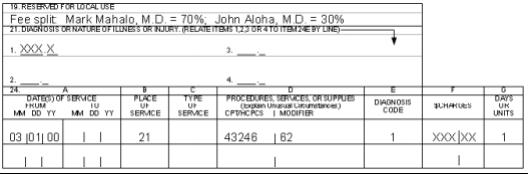
Both surgeons should bill using the same CPT procedure code (43246) and modifier code 62. Both surgeons should include a copy of the operative report, indicating the portion of the procedure each performed.
Plan benefits for the procedure will be paid based on 125 percent of the eligible charge. The surgeons in this example have arrived at a mutually agreeable percentage split of the fee (70/30) and have indicated this split on the claims (block 19). The claims should be completed as shown below:
Example 2 (appropriate use of modifier code 62)
Two surgeons perform a lumbar arthrodesis, anterior approach (CPT code 22558). A general surgeon performs the approach. An orthopedic surgeon performs the arthrodesis. The general surgeon closes. The surgery is appropriate for co-surgery.
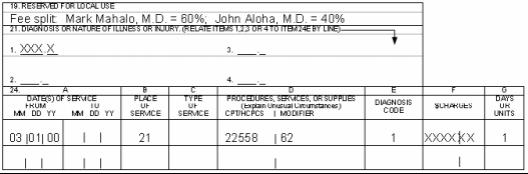
Both surgeons should bill using the same CPT procedure code (22558) and modifier code 62. Both surgeons should include a copy of the operative report, indicating the portion of the procedure each performed.
Note: The general surgeon should not report CPT code 49010 (exploration, retroperitoneal area) because the approach is considered to be a necessary part of the primary procedure and should not be billed separately.
Plan benefits for the procedure will be paid based on 125 percent of the eligible charge. The surgeons in this example have arrived at a mutually agreeable percentage split of the fee (60/40) and have indicated this split on the claims (block 19). The claims should be completed as shown below:
Example 3 (inappropriate use of modifier code 62)
Two surgeons perform two distinct procedures on the same patient on the same day. The first surgeon performs a modified radical mastectomy. The other surgeon performs a total abdominal hysterectomy. In this case the use of a modifier 62 is not appropriate, even though the surgeons are operating on the same patient on the same day.
Each surgeon will bill separately for their services. Billing is done in the usual manner. Plan benefits will be paid to both surgeons based on 100 percent of the eligible charge for the procedures they perform.
Surgeon A will bill as follows:
CPT Code
19307
Mastectomy, modified radical, including axillary lymph nodes, with or without pectoralis minor muscle, but excluding pectoralis major muscle
Surgeon B will bill as follows:
CPT Code
58150
Total abdominal hysterectomy (corpus and cervix), with or without removal of tube(s), with or without removal of ovary(s)
Example 4 (inappropriate use of modifier code 62)
Two surgeons perform a coronary artery bypass (CPT code 33533). The surgery is not a surgery for which co-surgery is appropriate.
Surgeon A (the primary surgeon) bills as follows:
CPT Code
33533-62
Coronary artery bypass, using arterial graft(s); single arterial graft
Surgeon B bills as follows:
CPT Code
33533-62
Coronary artery bypass, using arterial graft(s); single arterial graft
When a procedure does not routinely require the services of a co-surgeon, but requires the services of an assistant surgeon, plan benefits will be paid based on 120 percent of the HMSA's eligible charge. If the providers have indicated an agreed-upon fee distribution on their claims, HMSA will determine appropriate payment based on the percentage split indicated.
Note: If two surgeons perform a surgery together that does not ordinarily require the services of co-surgeons or an assistant surgeon, HMSA will split the fee according to the agreement indicated on the claims. The total amount of the split payment will be based on 100 percent of the eligible charge.
When multiple surgical procedures are performed during the same operative session, plan benefits will be paid at 100 percent of the eligible charge for the highest-valued procedure and 50 percent of the eligible charge for each subsequent procedure. The resulting allowance will then be adjusted and apportioned as described in the above examples.
Please be sure to use the most up-to-date industry-standard procedure, revenue, and diagnosis codes from the current CPT ®'', HCPCS Level II, and ICD-10-CM manuals, as recommended by the American Medical Association (AMA), the Centers for Medicare & Medicaid Services (CMS), and the American Hospital Association.
** Codes may not be all inclusive as the AMA and CMS code updates may occur more frequently.
Revision History
| Date | Nature of Revision |
|---|---|
| 08/03/2026 | Migrated to new platform |