Coding and Payment
Coding
Coding for anesthesia services rendered to ease a woman’s pain during labor and delivery is done in the same manner as other anesthesia coding. (See Anesthesia Services – General Information.)
HMSA recognizes the following anesthesia CPT codes for anesthesia services rendered during labor and delivery:
| Code | Description |
|---|---|
| 01960 | Anesthesia for vaginal delivery only. [Note: Anesthesia via epidural catheter should be billed using CPT code 01967.] |
| 01961 | Anesthesia for cesarean delivery only. |
| 01967 | Neuraxial labor analgesia/anesthesia for planned vaginal delivery (this includes any repeat subarachnoid needle placement and drug injection and/or any necessary replacement of an epidural catheter during labor). |
| 01968 | Anesthesia for cesarean delivery following neuraxial labor analgesia/anesthesia. (List separately in addition to code for primary procedure.) |
HMSA also recognizes the following modifier codes for anesthesia services during labor and delivery:
| Code | Description |
|---|---|
| AA | To represent general or regional anesthesia personally provided by a physician |
| QX | To represent general or regional anesthesia provided by a CRNA under the medical direction of a physician |
| QY | To represent medical direction of one CRNA by an anesthesiologist |
| QZ | To represent general or regional anesthesia provided by a CRNA without the medical direction of an anesthesiologist |
Coding for routine cesarean deliveries can be done using a one-line entry (see Example 1). However, when a delivery is planned as a vaginal delivery, but concludes as a cesarean delivery, two lines are required to clearly describe the services provided (see Example 2).
Example 1
A normal healthy patient receives general anesthesia for a cesarean delivery. Anesthesia was provided by a CRNA for 45 minutes without the medical direction of an anesthesiologist. The claim, which should be billed with minutes only, would be completed as follows:
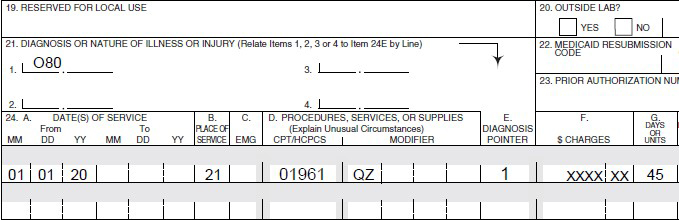
The only modifier needed in Example 1 is:
| Code | Description |
|---|---|
| QZ | To represent general or regional anesthesia provided by a CRNA without the medical direction of an anesthesiologist |
Example 2
Several hours into her labor, a healthy patient receives neuraxial anesthesia for a planned vaginal delivery. However, as labor progresses, the obstetrician notes that the fetus is experiencing distress and decides to do a cesarean section. The anesthesiologist was in attendance during labor for 4 hours and 30 minutes (270 minutes) and during the subsequent delivery for 1 hour and 15 minutes (75 minutes). The claim, which should be billed with minutes only, would be coded as follows:
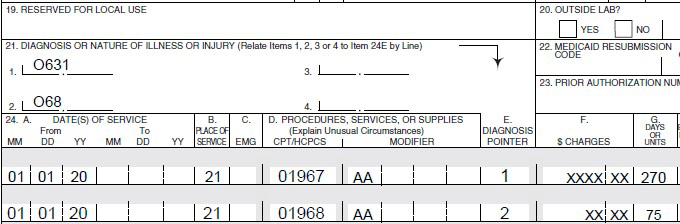
The only modifier needed in Example 2 is:
| Code | Description |
|---|---|
| AA | Indicating the anesthesia was personally performed by the anesthesiologist |
Payment
Payment for anesthesia services rendered during labor is calculated differently from that for other anesthesia services. Payment is made according to the unit values listed on the tables below. The global unit values shown on the table shown on the table represent a combination of the base units for anesthesia rendered during labor and time units.
| Time period | Unit Value |
|---|---|
| Up to 30 minutes | 7 |
| 45 minutes | 8 |
| 1 hour (60 minutes) | 9 |
| 1 ½ hour (90 minutes) | 10 |
| 2 hours (120 minutes) | 11 |
| 2 ½ hours (150 minutes) | 12 |
| 3 hours (180 minutes) | 13 |
For each additional hour beyond three, one more unit will be allowed. Thus, four hours would be valued at 14 units, five hours at 15 units, six hours at 16 units and so on. A maximum number of units will not be imposed, as long as services are still being rendered.
Revision History
| Date | Nature of Revision |
|---|---|
| 08/03/2026 | Migrated to new platform. |